All phishing is fraud.
Not all fraud is phishing.

Why the distinction matters, and what it costs you when it's ignored
The word “phishing” has become a catchall in brand protection.
When a fraudulent website targets your customers, it’s labeled phishing.
When a fake storefront misuses your brand to drive unauthorized sales, it’s labeled phishing.
When a scam page collects payment details through a checkout flow, it’s labeled phishing.
When these threats are misclassified, the impact isn’t just operational. It affects how quickly sites are removed, how customers experience your brand, and how confidently teams can report outcomes internally.
Here is the thing:
It is not all phishing. And the difference is not semantic.
Two threats. Two very different jobs.
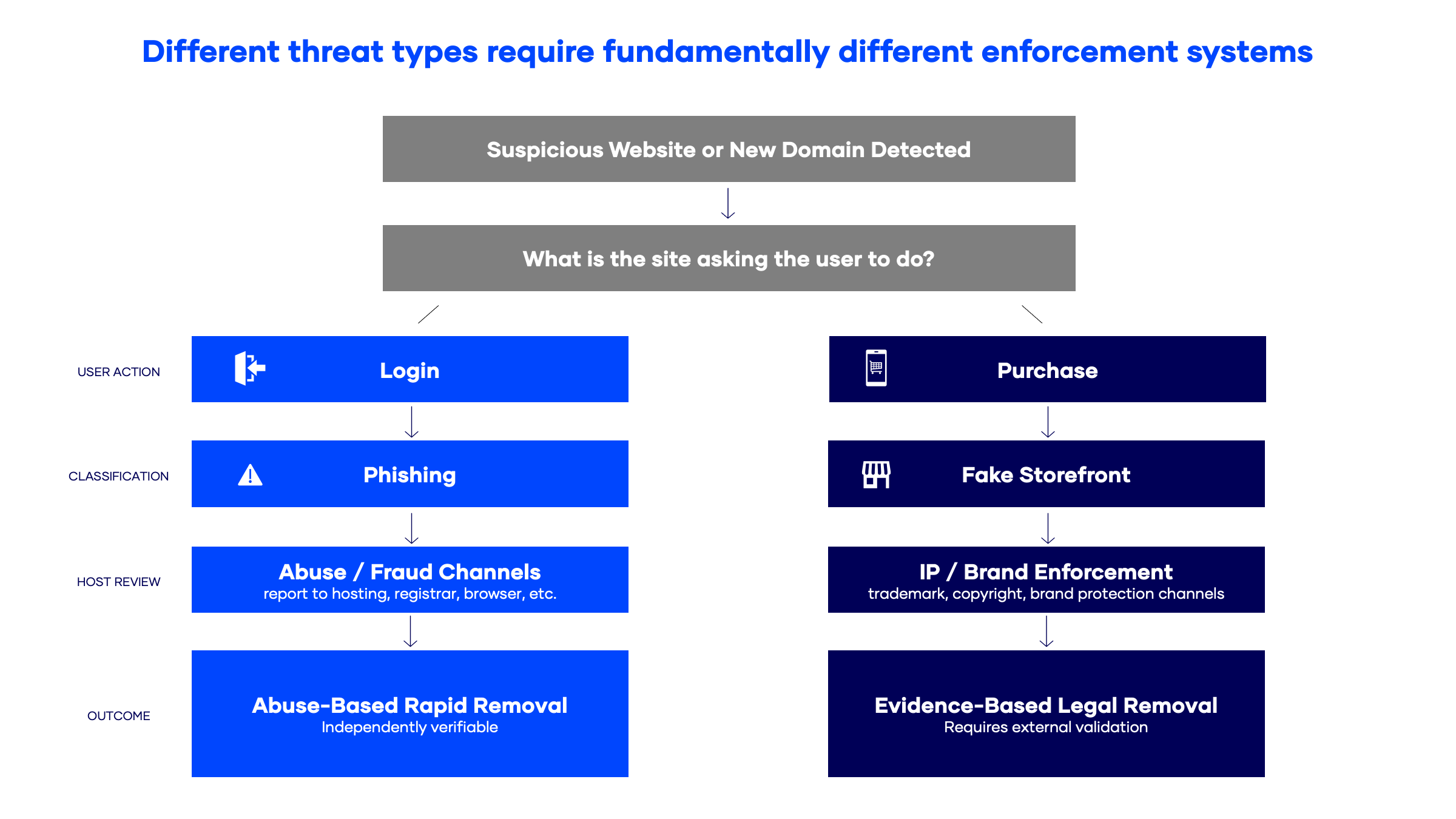
Phishing is designed to steal personal information.
Credentials, passwords, account logins. It works through social engineering: the site impersonates a trusted entity and tricks the user into handing over something they would never willingly give. A phishing site does not want your money. It wants your identity.
A fake ecommerce storefront wants the opposite.
It wants your customer to check out. Product listings, promotional pricing, a shopping cart, payment capture. These sites misuse your brand assets to appear legitimate and drive transactions.
A site asking you to log in is doing something fundamentally different from a site asking you to buy.
Both are fraud. They are not the same fraud.
Why the label you use determines the outcome you get
This is where misclassification stops being a terminology problem and starts being an enforcement problem.
Phishing is criminal conduct.
Hosts and abuse channels treat it as a priority because the harm is immediate and independently verifiable. When a site is genuinely phishing, it can be actioned quickly.
Fake storefronts follow a different path entirely.
Many look exactly like normal ecommerce. The harm is real, but proving fraudulent intent from the page alone is often not possible without brand-holder confirmation, test purchases or investigative evidence. Enforcement relies on trademark and copyright claims, documented brand misuse and signed authorization from the rights holder.
Submit a fake storefront as phishing and you risk rejection, delays while the case is re-triaged and referral back to the correct enforcement path.
The fastest path to a defensible takedown is the correct path.
What good looks like
Effective brand protection starts with knowing exactly what you are dealing with.
Classify phishing as phishing.
Classify fake storefronts as fake storefronts. Match the threat type to the enforcement channel and the evidence it requires. Report outcomes by category so your stakeholders can measure accurately and make decisions with a clear picture of actual brand exposure.
Speed and precision are not competing values.
A fast takedown that uses the wrong mechanism, gets rejected and has to be re-routed is not fast at all. Precision is what makes speed durable.
Before you evaluate any brand protection solution on its headline metrics, ask a few key questions:
- What exactly is being measured?
- Is response time measuring host acknowledgment, or actual site removal?
- Do the reported timelines hold across all threat types, or only the ones that move fastest?
Correct answers to those questions are what separate activity from protection.
Phishing and fake storefronts are both serious. They are not the same problem, and they should not be enforced, reported or evaluated the same way. Knowing the difference is not a technical detail.
It is the standard.
The good news is that this is not something you need to manage on your own. Work with us and we will take care of the issue, whether it is phishing or other fraudulent activity, we are on your side.
Our online fraud protection services are built around ensuring the right classification, enforcement, and reporting. If you want enforcement that is accurately classified, taken down through the right channel and reports in a way your legal and compliance teams can stand behind, we are here to help.
From character to consumer, Crane Authentication empowers the industry.
Ready to elevate your brand’s potential? Contact Crane Authentication to discover how our solutions safeguard brand revenue and reputations.